

Key Takeaways
- A Catapult Note uses the first observation date as the key decision point for the Note’s payoff path.
- If the underlier is positive or otherwise meets the call condition on the first observation date, the Note may be called and the investor may receive a fixed call premium, subject to the Note terms.
- If the Note is not called, the payoff may shift to an enhanced participation structure at maturity.
- Enhanced participation is not guaranteed upside. The final payoff still depends on underlier performance, protection terms, issuer credit risk, liquidity, and other conditions.
- Advisors should evaluate whether the client is comfortable with early call risk, holding-period uncertainty, and the downside scenario if the underlier declines.
Catapult Notes are a type of Structured Note where the first observation date can determine which payoff path the investor experiences: a fixed call premium if the Note is called, or enhanced participation at maturity if the Note remains outstanding.
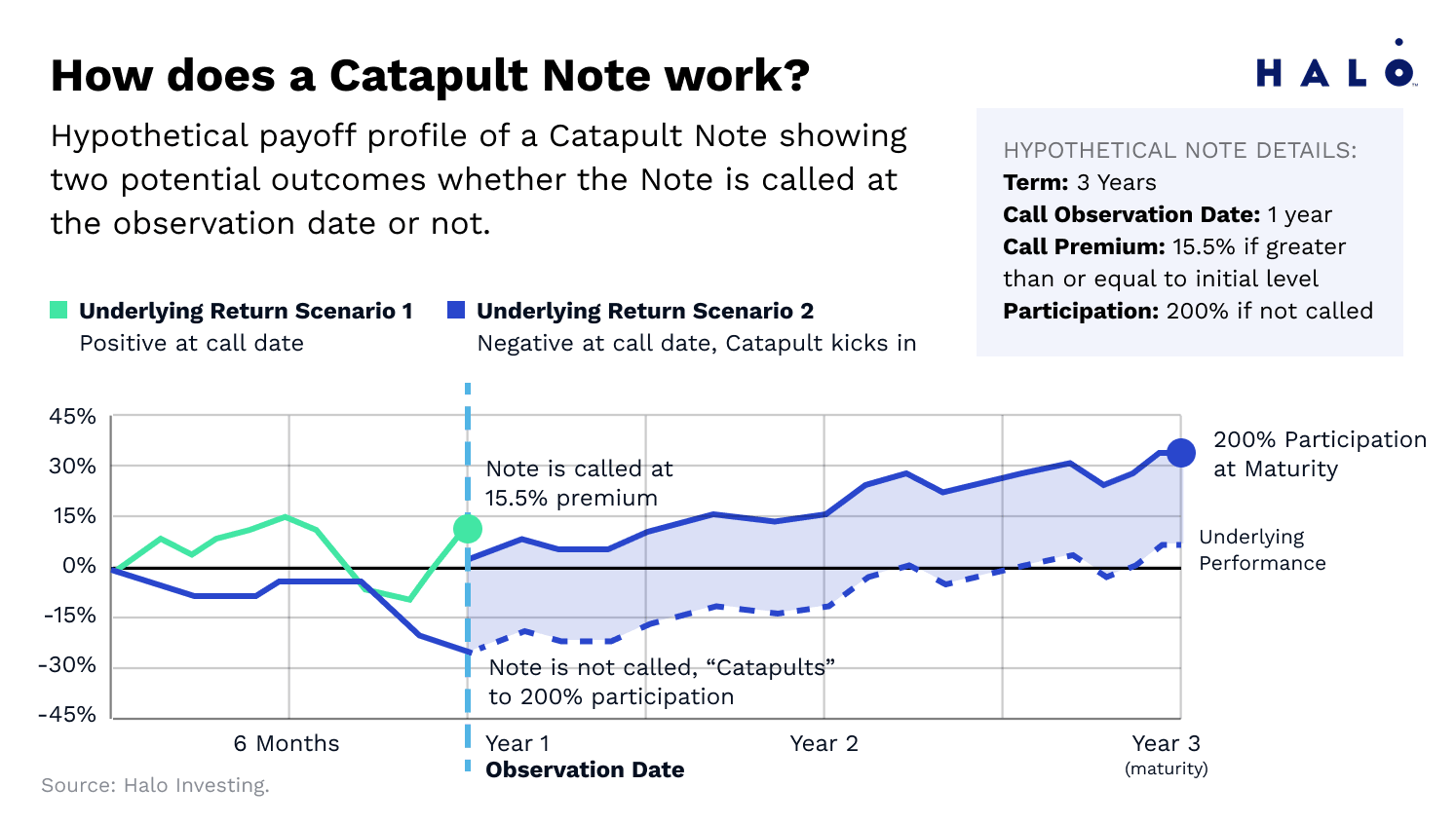
The first observation date is what makes the structure distinct. If the underlier closes above the required level, or otherwise meets the call condition, the Note may be called and the investor receives the stated call premium. If the underlier does not meet the call condition, the Note generally remains outstanding and the payoff may shift to enhanced participation at maturity.
The appeal is the two-path design, though investors must weigh these features against the loss of future appreciation if called early, issuer credit risk, and potential principal loss if the underlier declines. A Catapult Note can create a defined early-call opportunity while preserving a potential participation path if the Note is not called. The trade-off is that the second path still depends on market performance, protection terms, issuer credit risk, and the investor’s ability to hold the Note through the relevant period.
Definition: Catapult Structured Note
A Catapult Note is a type of Structured Note where the first observation date can determine whether the Note is called with a fixed call premium or remains outstanding with a potential enhanced participation payoff at maturity. The actual outcome depends on the offering terms, underlier performance, protection terms, and issuer credit risk.
How a Catapult Note Works
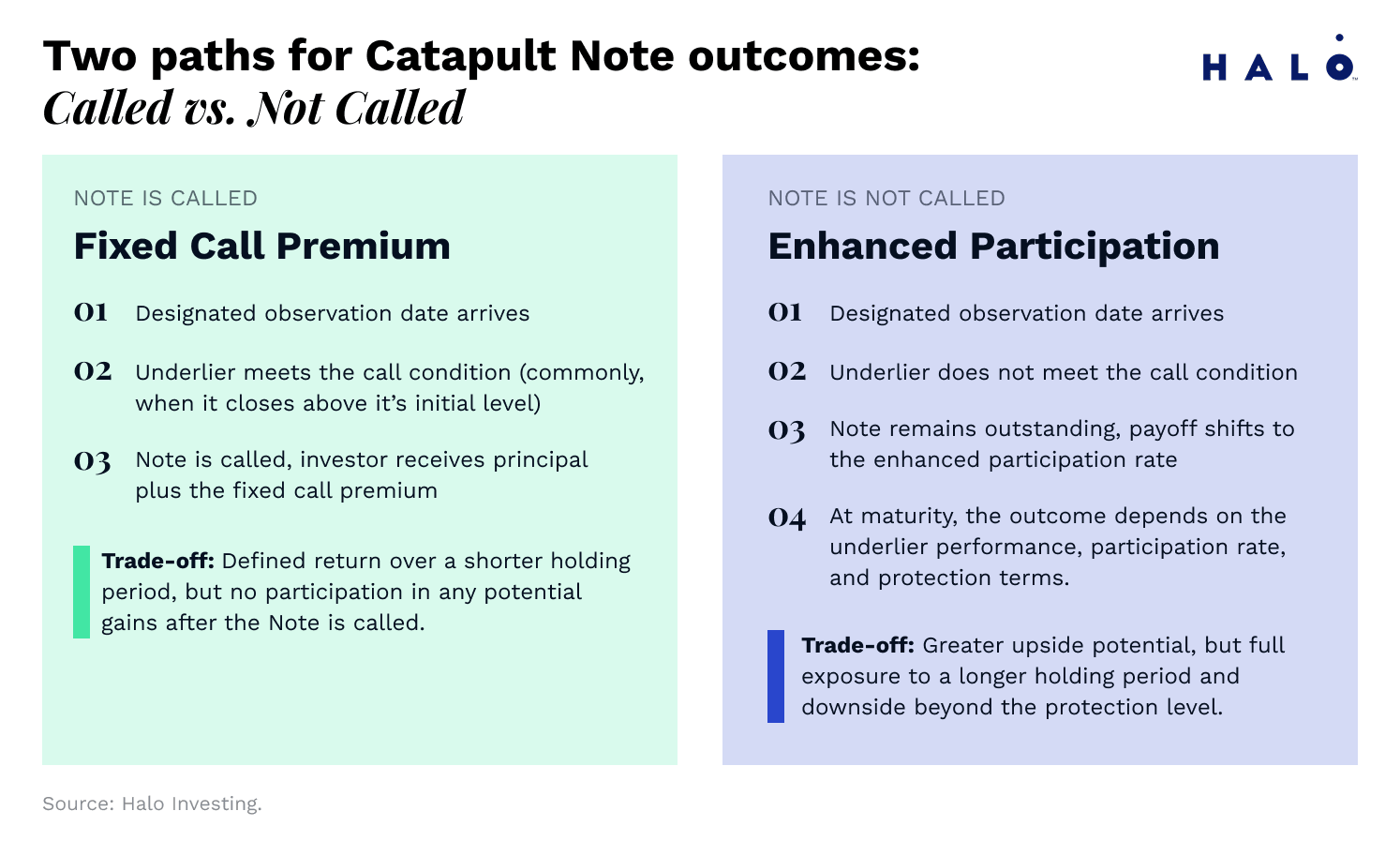
Catapult Notes are best understood as a sequence. The first observation date comes early in the term and determines whether the Note ends with a fixed call premium or remains outstanding for the enhanced participation path.
For advisors, each path creates a different risk-and-return conversation. In the called path, the investor may receive a defined premium over a shorter holding period, but gives up any later upside tied to the underlier. In the not-called path, the investor keeps exposure through maturity, where the final outcome depends on underlier performance, the participation formula, and any applicable protection terms.
The key is to evaluate both paths before focusing on the headline terms. The call premium may look attractive, and the participation rate may be compelling, but neither should be assessed in isolation. The structure needs to make sense whether the Note is called early or remains outstanding through maturity.
The First Observation Date: The Structure’s Turning Point
The first observation date is the point when the Note evaluates the underlier against the call condition. In many Catapult structures, the relevant comparison is whether the underlier is above its initial level, although the exact condition depends on the offering documents.
The observation date determines whether the Note may be called early or continue into the participation path. A positive underlier outcome may result in an early call, which ends the Note before maturity. A negative underlier outcome leaves the Note outstanding, extending the holding period; while this allows time for potential recovery, it also exposes the investor to further downside losses at maturity.
Advisors should be precise when explaining the observation date. The client should understand when performance is measured, what threshold is being used, and whether the result ends the investment or simply moves the Note into the next payoff path.
If the Note Is Called: Fixed Call Premium Outcome
If the underlier meets the call condition on the first observation date, the Note may be called. The investor generally receives principal plus the stated call premium, subject to the issuer’s ability to meet its obligations and the terms of the Note.
The fixed call premium may be attractive for clients who are comfortable receiving a defined return over a shorter period. The trade-off is that the Note duration ends. The investor does not continue into the enhanced participation path, even if the underlier later performs significantly better.
For portfolio planning, the early-call path introduces reinvestment considerations. Capital may return sooner than expected, and the advisor needs to decide how that capital should be redeployed based on current market conditions, available Note terms, and the client’s broader allocation.
If the Note Is Not Called: Enhanced Participation at Maturity
If the underlier does not meet the call condition on the first observation date, the Note generally remains outstanding. At that point, the payoff may shift into an enhanced participation structure that applies at maturity.
In this path, the payoff mechanism resembles a Growth Note at maturity, though unlike a traditional Growth Note, the investor must first pass through the initial observation test and remain subject to the note’s specific protection barriers. The difference is that the Catapult Note first passes through the initial observation-date test. The investor only reaches the enhanced participation path if the Note is not called.
Enhanced participation can give the investor a larger share of positive underlier performance if the underlier recovers by maturity. For example, a Note may offer a participation rate above 100%, meaning the investor’s potential return could be multiplied based on the underlier’s positive performance according to the Note’s structure.
Enhanced participation is contingent on the underlier’s performance at maturity. If the underlier remains negative or declines beyond the relevant protection level, the investor may receive a limited return or experience losses.
Where Protection Terms Enter the Outcome
Catapult Notes may include downside protection, such as Hard Protection or Soft Protection, depending on the Note design. The presence of a Catapult Note structure does not remove the need to evaluate protection terms carefully.
If a Note includes Hard Protection, the structure may absorb a stated amount of downside at maturity before investor losses begin, subject to issuer risk and the Note terms. If a Note includes Soft Protection, principal repayment may depend on whether the underlier remains above the stated level according to the observation terms. Either approach can affect the final outcome if the Note is not called and the underlier declines.
Advisors should also separate payoff potential from protection. A high participation rate may draw attention, but the downside terms determine how much risk remains if the underlier does not recover. The investor’s experience depends on both sides of the structure.
How the First Observation Date Can Shape the Final Outcome
The table below shows how a Catapult Note may follow different paths depending on the underlier’s level on the first observation date and its performance at maturity. The examples are simplified and for illustration only. Actual outcomes depend on the Note’s terms, underlier performance, call premium, participation rate, protection level, issuer credit risk, and any applicable fees or costs.
| Scenario | First Observation Date | Called? | Maturity Result if Not Called | Potential Takeaway |
|---|---|---|---|---|
| Underlier is positive at first observation | +6% versus initial level | Yes | Not applicable because the Note is called | The investor may receive principal plus the fixed call premium, subject to the Note terms. |
| Underlier is negative at first observation but recovers by maturity | -8% at first observation | No | +14% at maturity | Enhanced participation may create a positive payoff if the recovery satisfies the Note formula. |
| Underlier is negative at first observation and flat by maturity | -10% at first observation | No | Near initial level at maturity | The payoff may be limited or modest, depending on the participation formula and any required thresholds. |
| Underlier declines beyond the protection level by maturity | -12% at first observation | No | -35% at maturity | The investor may experience losses if the underlier breaches the relevant protection terms. |
When Advisors May Consider a Catapult Note
A Catapult Note may deserve consideration when the advisor can explain both payoff paths and the client is comfortable with either result. The structure may be relevant when a client wants a defined early-call opportunity but also values a participation path if the underlier is below the call condition at the first observation date.
A Catapult Note may be less appropriate when a client wants uncapped long-term participation, needs certainty around the holding period, or cannot tolerate losses if the Note is not called and the underlier declines. The Note can be difficult to explain if the client focuses only on the call premium or the participation rate without understanding how the observation date controls the path.
Advisors should frame Catapult Notes around fit and trade-offs. The structure can offer a defined early-call outcome and a potential enhanced participation path, but those features come with timing risk, reinvestment risk, issuer credit risk, liquidity limitations, and the possibility of loss.
Questions Advisors Should Ask Before Using a Catapult Note
A Catapult Note should be reviewed through both potential paths before the headline terms become the center of the conversation. Advisors need to understand what happens if the Note is called, what happens if the Note remains outstanding, and whether the client can tolerate the downside scenario if the underlier does not recover.
The following questions can help frame that review before moving from interest to implementation.
- What is the call condition on the first observation date?
- What call premium does the investor receive if the Note is called?
- What happens if the Note is not called and the payoff shifts to the participation path?
- What participation rate applies at maturity, and are there caps, thresholds, or other limits?
- What protection applies if the underlier declines, and when is that protection measured?
- How would the client feel if the Note is called early and the underlier continues to rise afterward?
- Can the client hold the Note if it is not called and liquidity is limited?
- How should issuer credit risk, fees, tax considerations, and early exit limitations be explained?
Glossary
| Term | Definition |
|---|---|
| Catapult Note | A type of Structured Note that may shift from a fixed call premium path to an enhanced participation path depending on the underlier’s level at the first observation date. |
| Growth Note | A type of Structured Note where payoff potential is generally tied to positive underlier performance at maturity, based on the Note terms. |
| Observation date | Date when the underlier is measured under the Note terms. In a Catapult structure, the first observation date is usually the key decision point. |
| Call premium | The fixed return the investor may receive if the Note is called, subject to the Note terms and issuer credit risk. |
| Participation rate | The percentage of positive underlier performance used to calculate the potential payoff at maturity. Some structures may offer participation above 100%. |
| Maturity | The date when the Note reaches the end of its stated term if it has not been called earlier. |
| Hard Protection | Feature that may absorb a stated amount of downside at maturity before investor losses begin, subject to issuer risk and the Note terms |
| Issuer credit risk | The risk that the issuing bank may be unable to meet its obligations under the Note. |
Advisor Takeaway
Catapult Notes are most useful when the advisor can evaluate both paths with equal discipline. The early-call path may offer a defined premium over a shorter holding period. The not-called path may preserve upside potential through enhanced participation at maturity. Neither path should be viewed in isolation.
Before considering a Catapult Note, advisors should look beyond the call premium and participation rate to the full structure: the underlier, call condition, protection terms, issuer credit risk, liquidity constraints, and client suitability. The goal is not simply to explain how the Note works, but to determine whether both potential outcomes fit the client’s objectives, risk tolerance, and time horizon.
FAQs
What is a Catapult Note?
A Catapult Note is a type of Structured Note that creates two potential payoff paths. If the underlier meets the call condition on the first observation date, the Note may be called with a fixed call premium. If the Note is not called, the payoff may shift to enhanced participation at maturity.
How is a Catapult Note similar to a Growth Note?
If a Catapult Note is not called on the first observation date, its payoff may shift to enhanced participation at maturity. At that point, it can resemble a Growth Note because the investor’s upside potential is tied to positive underlier performance, subject to the Note terms.
What happens if the underlier is positive on the first observation date?
If the underlier is positive or otherwise meets the call condition stated in the offering documents, the Note may be called. The investor may receive principal plus the fixed call premium, subject to the Note terms and issuer credit risk.
What happens if a Catapult Note is not called?
If the Note is not called, the Note generally remains outstanding and the payoff may shift to an enhanced participation structure at maturity. The final outcome depends on the underlier’s performance, protection terms, and the Note formula.
Does enhanced participation guarantee a positive return?
No. Enhanced participation only creates value if the underlier performs well enough by maturity according to the Note terms. If the underlier remains negative or declines beyond the relevant protection level, the investor may receive a limited payoff or experience losses.
What risks should advisors review before using a Catapult Note?
Advisors should review the call condition, call premium, participation rate, protection terms, issuer credit risk, liquidity limitations, tax considerations, early exit constraints, and client suitability.
Disclosure
An investment in Structured Notes may not be suitable for all investors. These investments involve substantial risks. The appropriateness of a particular investment or strategy will depend on an investor’s individual circumstances and objectives.
Content and any tools discussed are provided for educational and information purposes only. Halo Investing makes no investment recommendations and does not provide financial, tax, or legal advice. Any structured product or financial security discussed is for illustrative purposes only and is not intended to portray a recommendation to buy or sell a particular product or service.


