

Key Takeaways
- Implementing Structured Notes does not need to be framed as a wholesale portfolio overhaul.
- Advisors can use Structured Notes either as layered allocations or as targeted replacements.
- Layered allocations usually work best when the goal is to complement an exposure that still serves a useful role.
- Replacement allocations usually work best when part of an existing sleeve no longer fits the client’s objective or risk budget cleanly.
- The source of capital should be part of the allocation decision because equity, fixed income, and overall risk budget each create different portfolio trade-offs.
- Clear client communication starts with portfolio role before moving into product mechanics.
Structured Notes often make conceptual sense before advisors understand where they fit in the portfolio.
An advisor can explain the appeal clearly enough: more defined outcomes, a different income profile, or some measure of downside mitigation. A client nods along. Then the real portfolio question takes over: Where exactly would this fit?
Many conversations stall there. Product education isn’t actually the problem. Implementation usually is.
Two framing paths can be helpful. A layered allocation adds a Structured Note alongside an existing exposure. A replacement allocation uses capital from part of a current sleeve to fund the Note. The portfolio role should determine whether a Structured Note is layered in or used as a replacement. The allocation should have a clear purpose before the conversation moves to terms or mechanics.
Where Structured Notes Belong in the Portfolio Conversation
Portfolio conversations tend to lose shape when a position enters the discussion before its role is clear.
A client may understand the appeal of a defined outcome. A client may appreciate the logic behind contingent income. A client may even like the idea of more defined exposure. Portfolio construction still needs an answer to a simpler question: What job is this position meant to do?
Implementation framing answers that question early.
A layered approach tells the client, “We are adding a different outcome profile alongside an exposure that still belongs in the portfolio.” A replacement approach tells the client, “We are reallocating from a sleeve that no longer matches the objective as cleanly as it should.”
Advisors gain several advantages from that framing. Client communication gets clearer. Suitability discussions get sharper. Trade-offs move into the open. Portfolio construction starts to look deliberate rather than improvised.
Halo’s Asset Allocation Framework is built for exactly that kind of conversation. The audience here consists of institutional-minded, high-net-worth-focused advisors who want differentiated portfolio tools and a practical way to use them in real portfolio discussions.
Layering In: When a Structured Note Should Complement What Already Works
A layered allocation works best when an advisor wants to broaden the portfolio’s outcome set without dismantling an exposure that still serves a useful role.

Core equity may still belong in the account. A fixed-income sleeve may still earn its keep. The overall asset mix may still point in the right direction. A Structured Note can enter that setting as an overlay that adds a different payoff profile, risk contour, or income profile without forcing an all-or-nothing change to the existing architecture.
Three situations usually favor a layered path.
A first case appears when a client wants to stay invested in equities but feels less comfortable with the full range of downside. A Structured Note can sit alongside the existing equity sleeve and create a more defined experience for a portion of capital while leaving the broader equity exposure in place.
A second case appears when a client wants to explore a differentiated source of income without uprooting the entire income allocation. A Structured Note can complement bonds, dividend-oriented holdings, or other income strategies while pursuing a different set of terms and trade-offs.
A third case appears when an advisor wants to introduce Structured Notes gradually. Some clients respond better when a new allocation enters the portfolio as a measured addition rather than a visible substitution. A layered path can reduce friction by keeping the rest of the portfolio familiar while adding a tool with a specific purpose.
Layered allocations usually fit best when the advisor’s goal is to expand, refine, or diversify the portfolio’s outcome set rather than correct a direct mismatch in an existing sleeve.
A Layered Allocation Fits When…
- The current exposure still serves a useful portfolio role
- The advisor wants to introduce a new payoff profile without removing the original position
- The client prefers a measured addition rather than a more visible reallocation
- The allocation is meant to complement, not replace, the existing sleeve
Replacing With Intention: When a Current Sleeve No Longer Fits the Job
A replacement allocation demands more judgment from the advisor and often delivers a more direct portfolio result.
A replacement path makes sense when an existing sleeve no longer fits the client’s objective, risk budget, or desired outcome as well as it once did. An advisor is not simply adding another instrument to the mix. An advisor is making an active portfolio decision: part of what sits here today could be expressed more effectively another way.
Client needs often change faster than portfolios do. A fixed-income allocation may still provide ballast, but part of it may no longer deliver the kind of income, time-horizon fit, or outcome precision the client wants. An equity sleeve may still be directionally appropriate, but part of it may expose the client to more downside volatility than the client is willing to absorb. A replacement strategy allows the advisor to address the mismatch directly rather than layering new exposures on top of an increasingly outdated structure.
Replacement allocations usually force a more explicit trade-off conversation. A client can see what is being trimmed, what is taking its place, and why the shift is happening. Portfolio intent becomes easier to articulate. Portfolio accountability becomes easier to defend.
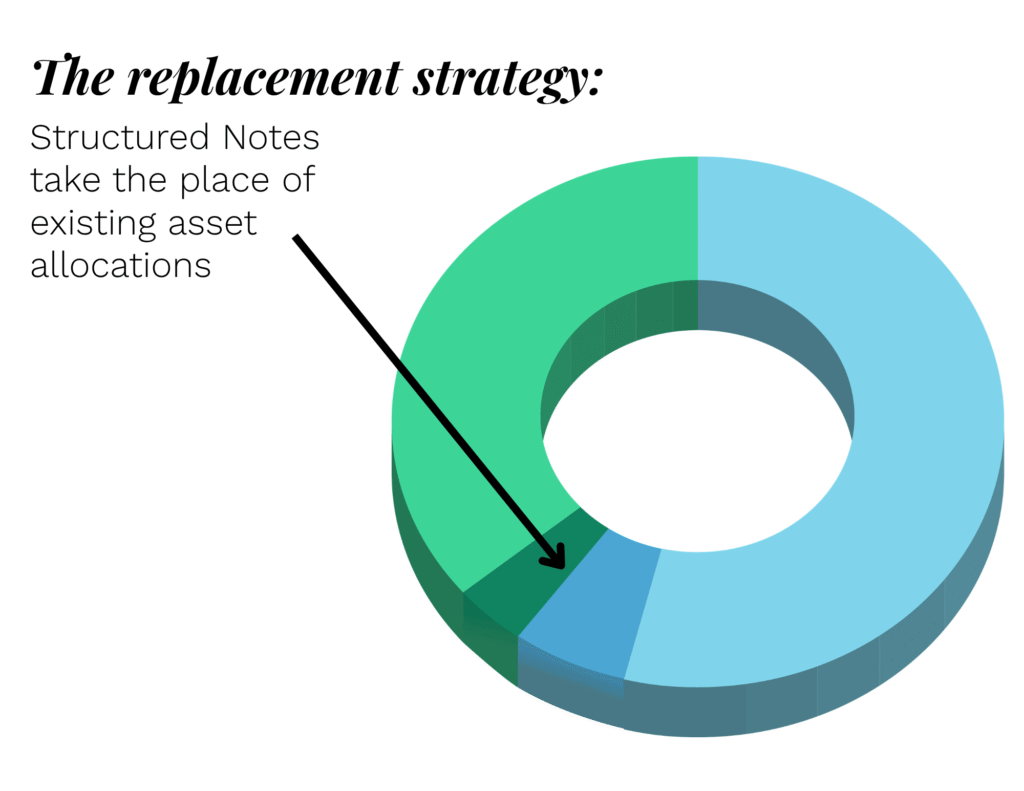
Replacement allocations usually fit best when the advisor’s goal is to upgrade, reshape, or reposition an existing sleeve rather than simply add another moving part.
Useful Rule of Thumb
Layered allocations usually answer the question, “How can we complement what already works?”
Replacement allocations usually answer the question, “Which part of the current portfolio no longer fits the job as well as it should?”
Choosing the Source of Capital: Equity, Fixed Income, and Risk-Budget Trade-Offs
The source of capital is the part of the portfolio that would be trimmed, redeployed, or otherwise used to fund the Structured Note allocation. It may come from an equity sleeve, a fixed-income sleeve, or another part of the portfolio based on the client’s broader risk budget.
Advisors weighing a layered or replacement path should identify that source before reviewing note terms. The starting point is the capital being redeployed, the role that capital currently plays, and the trade-offs the portfolio will absorb once the allocation is made.
From Equity
Equity-funded Structured Notes may appeal when a client wants to keep market exposure but prefers a more defined outcome profile for part of that sleeve. A layered version may sit alongside core equity holdings. A replacement version may trim part of a more volatile or more open-ended exposure.
From Fixed Income
Fixed-income-funded Structured Notes often enter the conversation when a client needs a different balance between income potential, downside profile, and outcome precision. Advisors need to be careful here. A Structured Note does not simply become “fixed income, but better.” A Structured Note changes the shape of the allocation, the source of return, and the client conversation around risk. Role clarity matters.
From the Portfolio Risk Budget
Some of the best portfolio conversations begin not with an asset class but with a risk budget. How much open-ended equity risk does the client want? How much uncertainty can the client tolerate in exchange for a different payoff profile? How much liquidity flexibility exists during the life of the investment? A risk-budget lens often reveals whether the note should complement the portfolio or replace part of it.
Two questions can sharpen the decision quickly:
- Which role is losing effectiveness inside the portfolio?
- Which role needs more precision?
Good answers point toward the right source of capital and implementation path.
Two Portfolio Scenarios That Bring the Distinction Into Focus
Portfolio logic usually becomes clearer once the allocation decision is placed in a real client setting. One scenario shows how a Structured Note can complement an exposure that still works; the other shows how it can replace part of a sleeve that no longer does.
Scenario 1: Layering Protection Alongside Equities
An advisor works with a client who remains constructive on equities but has grown more sensitive to downside after a volatile stretch. The client does not want to reduce core equity exposure dramatically. The advisor uses a Structured Note as a layered allocation alongside the existing equity sleeve, introducing a more defined outcome profile on a portion of capital while keeping the broader equity position intact.
The portfolio message is straightforward: We are not replacing your broader equity exposure. We are adding a sleeve designed to create a different experience for part of the allocation.
Scenario 2: Replacing Part of Fixed Income
An advisor works with a client who still needs income and capital discipline but finds part of the fixed-income sleeve less compelling given current portfolio goals. The advisor evaluates whether reallocating a portion of that sleeve into a Structured Note could create a more appropriate balance of income potential, defined terms, and portfolio fit.
The portfolio message changes: We are not simply adding another income idea. We are replacing part of an allocation that no longer matches the job as cleanly as it should.
Decision Shortcut
- Use layered when the portfolio needs a complementary outcome profile
- Use replacement when an existing sleeve no longer fits the job cleanly
- Use the source of capital to pressure-test whether the move makes portfolio sense
- Use client language that explains the role before the mechanics
How to Position the Allocation in the Client Conversation
Portfolio logic needs to be easy to explain before product mechanics ever have a chance to matter.
Clients do not need a full tutorial on structure design to understand why an allocation belongs in the portfolio. Clients need a clear explanation of role, reason, and trade-off: why the note is there, what job it is meant to do, and why a layered or replacement path makes sense in context.
A few questions keep the discussion disciplined:
- What role is the Structured Note meant to play inside the allocation?
- Why does a layered or replacement path make more sense for this client?
- What trade-offs come with the decision?
- Which sleeve is providing the capital for the allocation, and why?
- How does the approach align with the client’s goals, constraints, and suitability profile?
- Can the client explain the purpose of the position in plain language?
Strong positioning language often sounds simple:
- “We are adding this because it complements what you already own.”
Or:
- “We are replacing part of this sleeve because the current exposure no longer fits the job as cleanly as it should.”
Clarity travels well in client meetings … Complexity rarely does.
A Clearer Way to Bring Structured Notes Into the Portfolio
Structured Notes earn their place in a portfolio the same way any allocation should: by solving for a real need with a clearly defined role.
Some situations call for a layered approach. An existing exposure still works, but the advisor wants to add a different outcome profile alongside it. Other situations call for a replacement decision. Part of the portfolio no longer matches the client’s objective, risk tolerance, or desired trade-off as well as it should, and the allocation needs to be reworked with more intention.
A more useful framing starts there. The question is no longer whether Structured Notes belong in the portfolio in the abstract. A better question asks where they belong, what capital they should replace or complement, and what job they are expected to do once they are there.
Advisors who frame the decision that way tend to have stronger conversations surrounding Structured Notes. Clients see the portfolio logic more clearly. Trade-offs become easier to explain. Implementation starts to feel deliberate rather than product-led.
Get started with Structured Note implementation:
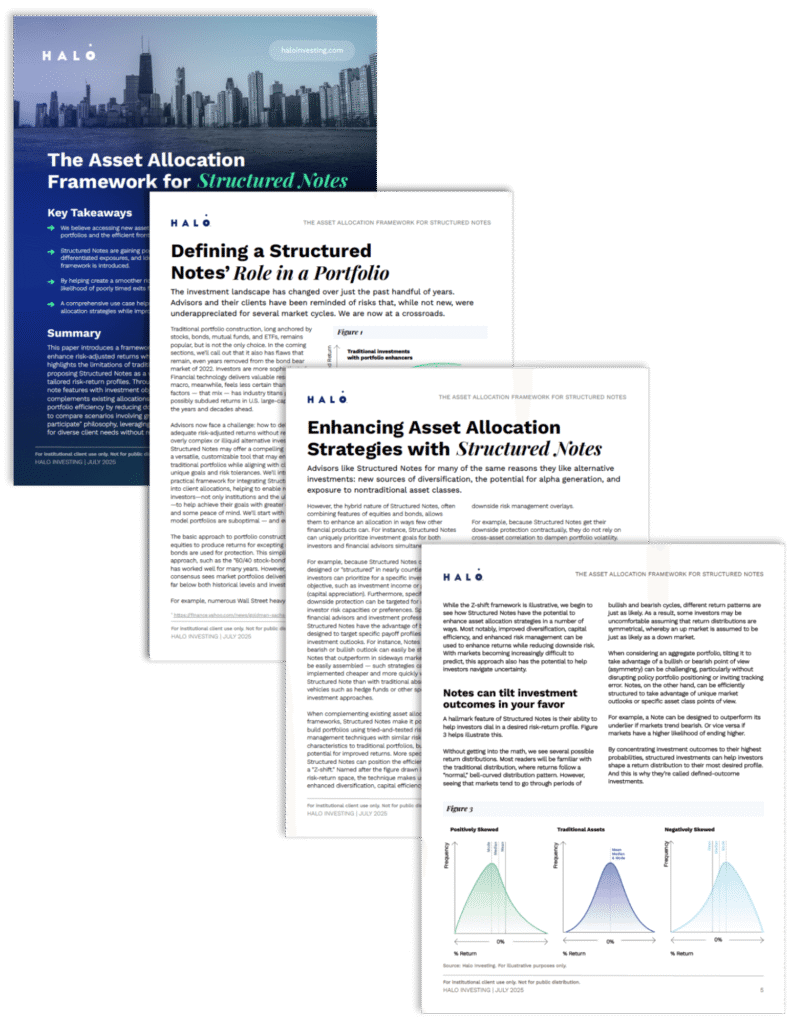
Review Halo’s Asset Allocation Framework to evaluate how Structured Notes may fit relative to an existing allocation, and speak with Halo about which implementation path may best align with a client’s goals, constraints, and suitability profile.
FAQs
What is the difference between a layered and replacement allocation for a Structured Note?
A layered allocation adds a Structured Note alongside an existing exposure to introduce a different outcome profile without removing the original position. A replacement allocation funds the Structured Note by trimming part of a current sleeve that may no longer fit the client’s objective, risk budget, or desired trade-off as cleanly as it once did.
When does a layered allocation make more sense than a replacement allocation?
A layered allocation often makes more sense when the current exposure still serves a useful role in the portfolio and the advisor wants to complement it rather than displace it. Advisors may take that route when introducing Structured Notes gradually, adding a differentiated payoff profile, or creating more defined outcomes for a portion of capital without making a more visible reallocation.
When should an advisor consider using a Structured Note as a replacement allocation?
A replacement allocation may deserve consideration when part of an existing sleeve no longer aligns well with the client’s goals, income needs, risk tolerance, or time horizon. In those cases, the Structured Note is not simply an add-on. It becomes a more direct portfolio decision tied to the role that sleeve is supposed to play.
Disclosure
An investment in Structured Notes may not be suitable for all investors. These investments involve substantial risks. The appropriateness of a particular investment or strategy will depend on an investor’s individual circumstances and objectives.
Content and any tools discussed are provided for educational and information purposes only. Halo Investing makes no investment recommendations and does not provide financial, tax, or legal advice. Any structured product or financial security discussed is for illustrative purposes only and is not intended to portray a recommendation to buy or sell a particular product or service.