

Key Takeaways:
- The AI trade unraveled in July as semiconductor equities plunged, a high-profile hedge fund collapsed, and leveraged investors from South Korea to Wall Street were forced to unwind crowded positions
- Despite historic volatility beneath the surface, the S&P 500 was flat last month
- Bond yields are climbing, Fed policy is in focus, and AI spending faces greater scrutiny heading into late summer
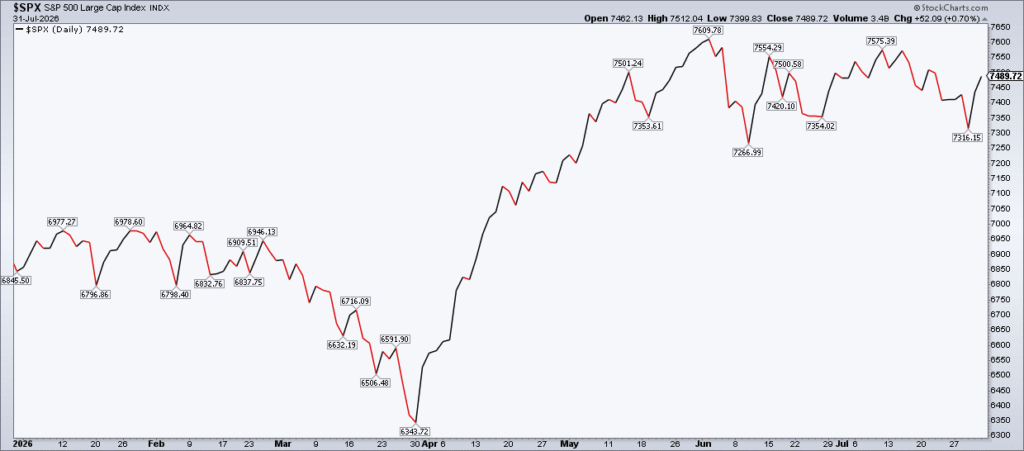
The AI trade unwound in July, a month that included a hedge fund collapse and a high-profile rescue by one of Wall Street’s biggest players. Drama aside, the S&P 500 was little changed last month, losing just 0.13%, but “flat” does not describe some of the outright historic swings seen among semiconductor and other AI-related stocks.
The Nasdaq Composite fell 3.2%, while the more AI-exposed and top-heavy Nasdaq 100 shed 6.6%, its worst month since March 2025 and its weakest July performance since 2004.
The S&P 500 Is Flat Since Mid-May, With Volatility Under the Surface
Source: Stockcharts.com
The semiconductor sector experienced the sharpest pullback, with the Philadelphia Semiconductor Index declining 20.6% during the month. And it wasn’t just tech-direct names caught up in the bearish action. Power producers, data center buildout players, and manufacturers of AI infrastructure were pummeled up until the final days of the month. Caterpillar (CAT) was a case in point; the Industrials-sector stalwart and second-largest weighting in the Dow 30 plummeted by more than 23%, its worst month since January 2009.
For investors, it’s a reminder that red-hot thematic plays can quickly turn south. Volatility indeed increased on the way up within the VanEck Semiconductor ETF (SMH) and geographically with the iShares MSCI South Korea ETF (EWY). Those funds (and other AI-specific products) peaked in May and June, then cascaded lower into the close of the first half. Rising interest rates and questions surrounding the sustainability of intense capital expenditure plans among the so-called “hyperscalers” sparked episodic selling days. String losses together on ETFs with implied volatility of 50% or more, and a 20% “bear market” can come about in short order.
The Cboe S&P Constituent Volatility Index (VIXEQ) Rose to 52-Week Highs in July, Above 50

Source: TradingView
Leverage Cuts Both Ways
There was also leverage in the system. As mentioned before, South Korean investors were highly exposed to just two memory chipmakers. Samsung and SK Hynix (SKHY) swelled to more than $1 trillion in market cap each over the first half of 2026. South Korean households began trading their country’s stocks like little hedge funds of their own.
According to CNBC, retail traders there piled in, buying upwards of $10 billion of equities in a single day (compared to less than $2 billion by other investors). They were lured into the South Korean KOSPI Index’s meteoric ascent from 2285 in April last year to a peak of 9385 on June 19. It was a textbook speculative bubble, and like all bubbles, it eventually burst.
Amid the July crash, it was estimated that 3.4% of the South Korean adult population received a margin call. Regulators then stepped in. Trading curbs on high-risk leveraged ETFs were put in place, along with an apology from the country’s policymakers. All told, EWY lost 35% in less than six weeks before bouncing into July’s close.
The KOSPI Index Crashed from Late June Through Late July

Source: The Daily Shot
Drama unfolded closer to home, too. Situational Awareness, a California-based hedge fund launched in 2024 by Leopold Aschenbrenner, a former OpenAI “Superalignment” researcher, collapsed as AI stocks reached a selling crescendo. We never know the exact details or timing, but the highly concentrated and leveraged strategy entailed going long AI infrastructure stocks and short software incumbents.
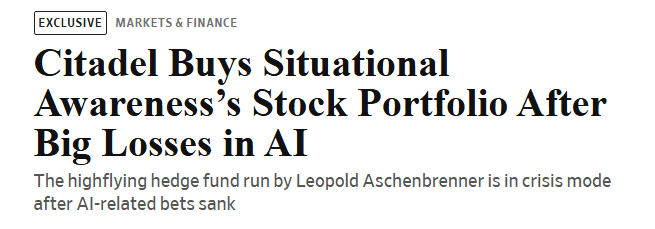
Essentially, it was an aggressive wager on AI growth persisting. The hedge fund produced incredible results through much of the first half of 2026, but Wall Street had other ideas in July. It was reminiscent of past hedge fund blowups, Long-Term Capital Management in 1998, Archegos in 2021, where a concentrated, leveraged bet went from brilliant to catastrophic once market momentum reversed. According to the Wall Street Journal, Citadel Securities, one of Wall Street’s most established players, stepped in to buy Situational Awareness’s public portfolio at a significant discount.
Chip stocks and AI-related names rallied once the dust settled, a favorable turn for Citadel, which had just acquired a distressed AI-heavy portfolio.
Hedge Fund Loses, Wall Street Wins
Source: The Wall Street Journal
The VIX Didn’t Tell the Story
From South Korea to California to offices and households across the country, risk happens fast. That’s the point. Investors must be vigilant, proceeding with caution when navigating increasingly volatile markets. Today, you wouldn’t know how precarious equities are by simply looking at the Cboe Volatility Index (VIX). Wall Street’s fear gauge settled July at a calm 16 and change. Amid all the aforementioned madness, the VIX never got above 21.
Hence, protective investment strategies are not simply linked to broad volatility measures. As the bull market that began in October 2022 matures, pockets of volatility seem to come out of the woodwork and spook the big indexes. One prudent takeaway is to make sure your equity holdings aren’t entirely moored to a single thematic storyline. Sure, some AI exposure can make sense, but don’t discount what’s happening away from that sexy growth narrative.
Just take a look at some “real economy” stocks. By early August, blue-chip companies like Coca-Cola (KO), Johnson & Johnson (JNJ), Visa (V), and 3M (MMM) were at or near 52-week highs. At the sector level, the S&P 500 Information Technology space performed the worst, down 3.5%, while Energy, Financials, Real Estate, Health Care, and Consumer Staples posted positive returns to begin the second half.
Among the many diversification indicators analysts watched last month was strength in the S&P 500 Equal Weight Index. Naturally, there’s an ETF for that, and “RSP” notched one record high after another as the cap-weighted index sagged.
July S&P 500 Sector Performances: Energy Best, Tech Worst

Source: Stockcharts.com
The Bond Market Speaks
Theatrics were not confined to retail investor leverage and hedge fund liquidations, either. The July Fed meeting was box-office stuff. The Federal Open Market Committee’s (FOMC) decision to leave its policy rate unchanged wasn’t, by itself, compelling. Fed Chair Kevin Warsh’s July 29 press conference drew a skeptical reaction from reporters and economists, though.
His responses on monetary policy guidance and the Fed’s ‘reaction function’ left markets wanting clarity, and the bond market filled in the blanks. The yield on the 30-year Treasury bond soared to a fresh high since the Great Financial Crisis, above 5.25%. The “long bond” settled July at its highest monthly yield since July 2004.
30-Year Treasury Yield: Highest Monthly Print in More than Two Decades

Source: TradingView
Steeper borrowing rates are problematic for companies embarking on ambitious capital projects requiring external debt financing. Do any spring to mind? Perhaps the AI hyperscalers (Microsoft, Alphabet, Amazon, Meta, Oracle, and perhaps even Tesla and SpaceX, to an extent). CEOs and CFOs across the tech space may have some late-summer soul-searching to do as it pertains to what they are willing to spend in pursuit of AI dominance.
As for the Fed, the market is confident that rate hikes will happen eventually. Odds of a quarter-point increase are two-in-three for the September 16 decision, while the Fed funds futures market prices in a second hike by early 2027. Bond traders even discount the chance of a third hike.
Why does it matter? Well, higher short-term borrowing costs crimp credit growth, which helps cool the economy and stymie the money supply. That could govern the high-speed AI buildout while keeping tech-related valuations in check. At the moment, the long end of the Treasury curve is doing plenty of hawkish heavy lifting, and don’t ignore the loftier 10-year rate, which closed July at an 18-month zenith, near 4.75%.
One or Two Fed Hikes Priced Into Year-End

Source: Augur Infinity
It’s Still About Earnings
But could rates be on the boil for the right reasons? Maybe so. Consider that forward breakeven inflation rates are very tame, near 2.3%. Sure, an intense supply of corporate debt and the ongoing federal fiscal mess are bearish for bonds, but U.S. GDP growth hums along, and corporate profits are nothing short of through the roof. In key niches, the domestic economy is hot (just don’t look at housing or manufacturing ex-AI).
To that end, let’s double-click on S&P 500 earnings. FactSet notes that Q2 EPS is now pacing for a stunning 47.4% year-over-year growth rate. Put bluntly, we simply don’t see that unless the economy is emerging from a recession. To be clear, a chunk of the profit gains is driven by a handful of tech firms and “other income” related to equity gains on company balance sheets. Still, estimates are that the average stock is growing its bottom line at a low-teen rate.
Bulls say earnings drive this bull market; bears say we are not in an equity bubble, but an “earnings” bubble. Time will tell.
S&P 500 Earnings Growth: Best Since Q2 2021

Source: FactSet
The Bottom Line
July certainly delivered a wild sequence of events across global markets. An epic boom and bust in South Korea was followed by a classic hedge fund implosion at home. All the while, the “average stock” fared fine, and diversified investors remained largely unscathed. The July FOMC press conference didn’t ease market uncertainty, and the bond market acted as a villain to tech executives looking to borrow to further fuel the AI buildout.
Investors must widen their aperture to protect their portfolios as new risks shape markets.
Disclosure
An investment in Structured Notes may not be suitable for all investors. These investments involve substantial risks. The appropriateness of a particular investment or strategy will depend on an investor’s individual circumstances and objectives.
Equities, ETFs, and fixed-income securities involve risk of loss. Past performance is no guarantee of future results. Diversification does not assure a profit or protect against loss in declining markets.
Content and any tools discussed are provided for educational and information purposes only. Halo Investing makes no investment recommendations and does not provide financial, tax, or legal advice. Any structured product or financial security discussed is for illustrative purposes only and are not intended to portray a recommendation to buy or sell a particular product or service.